Technical & consumer
PP spunbond nonwoven
Continuous-filament polypropylene spunbond, absorbent or repellent, with FR options.
- Industry
- Healthcare, Industrial
- End use
- Technical & consumer
- Material
- Nonwoven
- Technology
- Spunbond
Overview
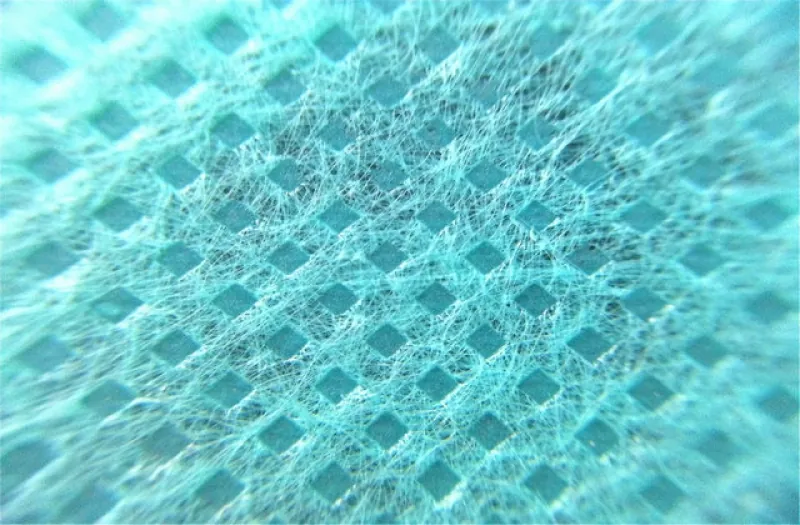
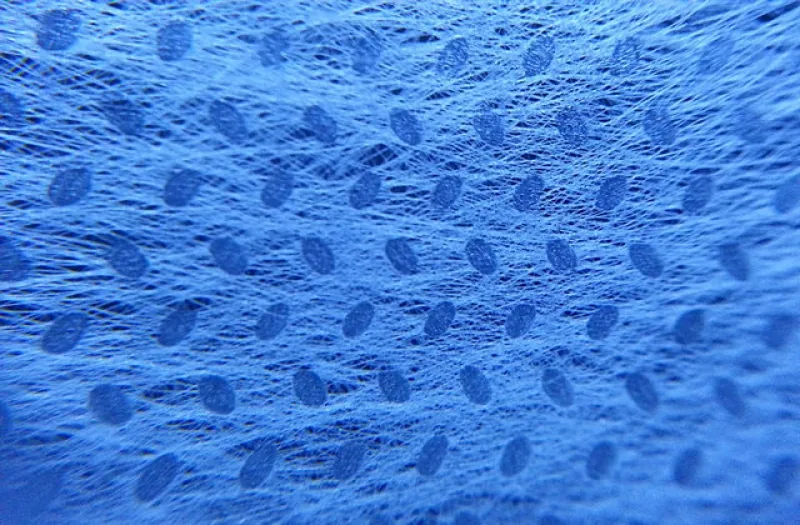
In spunbond production, polymer granules are melt-extruded and spun directly into continuous filaments, which are formed into the nonwoven web. The fibre-making and web-forming steps of other textile routes are therefore bypassed. Filament distribution is even, and continuous filaments give the fabric high final strength. The strength ratio is approximately 2 : 1 between machine and cross direction.
Fabrics can be finished as absorbent or repellent. Absorbent grades are expected to absorb liquid in under 2 seconds; repellent grades are expected to resist at least a 60 cm H₂O column. They are generally used in medical and industrial products, disposable operating-room covers, visitor fabrics and doctors' clothing.
UV-protected versions can be made for outdoor exposure. Flame-retardant versions are produced to DIN 4102, FMVSS 302, ISO 4589-1, EN 13984 and EN 13859, including FR to EN 13501-1 (class B2 stated).
Specification
- Raw material
- 100 % polypropylene (PP)
- Surface density
- 10–150 g/m² (12–150 g/m² on rolls)
- Net width
- 1.6 m
- Strength ratio MD : CD
- ≈ 2 : 1
- Absorbent grade
- Absorption in under 2 s
- Repellent grade
- ≥ 60 cm H₂O
Applications & typical end uses
- Medical and industrial products
- Disposable operating-room covers
- Visitor fabrics
- Doctor dress
Standards & test references
- DIN 4102
- FMVSS 302
- ISO 4589-1
- EN 13984
- EN 13859
- EN 13501-1 (B2)